RESULTS AND RESOURCES
RESULTS
From $60M to $1B:
How On3 Helped Marshall Financial Turn Acquisitions into a Scalable Growth Engine
When Pete Marshall first called On3, he didn’t need convincing that acquisitions could grow his advisory firm. He already had proof.
Working within his broker-dealer’s network, Pete’s firm, Marshall Financial, had completed a couple of small practice acquisitions. He’d seen firsthand that buying books of business from retiring advisors was a powerful way to add households and assets. What he didn’t have was the infrastructure to keep doing it.
The Challenge: A Family Firm at a Breaking Point
Marshall Financial started out as a small, family-style practice: Pete as the lead advisor, his wife helping as needed while juggling young kids, and a couple of young staff members. On paper, the practice looked promising, with about $60 million in AUM, an acquisitions-based growth strategy, and a pipeline of older advisors open to succession conversations.
But after his first acquisitions, major cracks in the operational foundation opened up. Pete’s small team lacked adequate administrative support and had difficulty incorporating new books of business. His young employees struggled to problem solve, and eventually, both staff members left.
Pete and his wife ended up cancelling their 10-year wedding anniversary trip because there was no one in the office to keep the business running. That was the moment Pete understood: the firm needed a different model, not just more hands.
The Plan: Implement On3’s Practice Builder Process
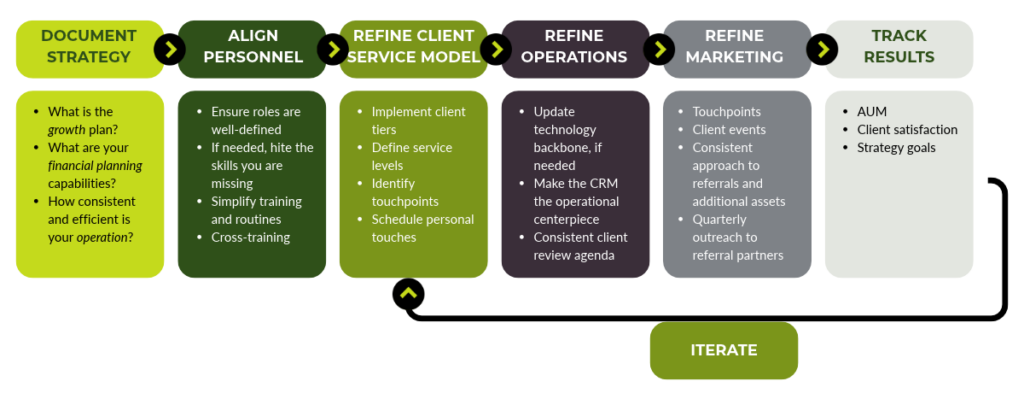
On3’s Practice Builder Process deploys proven service models, workflows, and technologies to fill the gaps that prevent successful practices from moving forward. The Process was developed by On3’s team of experienced practitioners who understand the dynamics of practice growth.
In Marshall’s case, the strategic evaluation was straightforward:
- Marshall had a well defined and tested growth plan
- Financial planning and client service capabilities were overwhelmed
- The firm lacked an effective operational foundation to support the growth plan
The On3 process then provided a game plan for prioritizing the firm’s operational and administrative gaps to relieve pressure and create a real base for growth.
Step One: Address Personnel Gaps
If acquisition was the growth strategy, that meant onboarding would become a critical capability. On3’s first act was to facilitate the hiring of a high-quality administrative lead, whose job was explicitly to run the office, support onboarding, and manage paperwork.
With the administrative foundation in place, On3 helped Pete expand his advisory bench. Again, On3 facilitated bringing on a seasoned financial planner to handle complex planning and anchor client relationships so Pete could lean fully into sourcing and closing deals. On3 also reached into its extensive network to bring in a junior employee who was excellent at managing back-office processes.
Step Two: Build an Operational Backbone
The key to an acquisition strategy is to ensure new clients are immediately and consistently happy with their new advisor. On3 helped Marshall map and implement repeatable processes that prioritized client service and practice capabilities.
Each of those processes was documented and, wherever possible, built into the CRM in the form of workflows and task sequences. The result was a firm where everyone, including new hires, could plug into a defined way of doing business.
Step Three: Uncover “Hidden” Assets
The secret sauce of the Marshall story is what happened when operational discipline was applied to business development. On paper, a typical acquisition might involve $40–50 million in assets. In practice, that was just the starting point.
With On3’s help, Marshall set up an onboarding process that helped the team uncover:
- Assets held at other institutions
- Dormant 401(k)s and old employer plans
- Bank accounts with large idle balances
- New capacity to save when life circumstances changed (e.g., when a client finished paying college tuition)
Marshall encountered cases where a $50 million acquisition would yield an additional $10–20 million in “found money” that could readily be added to the firm’s AUM.
Step Four: Implement Uniform Investment Models
On3 helped Marshall create a standardized set of portfolio models that can be used consistently across many clients. The models could be implemented to meet a wide range of client needs, generating predictability in both administration and outcomes. Clients with similar objectives would receive substantially the same investment strategy, which limited research and monitoring demands and simplified rebalancing and other adjustments.
The Outcome: From $60 Million to More Than $1 Billion
Pete’s relationship building and On3’s structural support proved a highly effective combination. Over roughly eight years of working together:
- Marshall grew from about $60 million in AUM to approximately $1 billion.
- The firm developed a repeatable acquisition-and-integration engine, targeting roughly one acquisition per year.
- The practice was no longer a family affair held together by effort; it was a scalable business with broad potential.
Building a practice is mathematical. Reach out to us at On3 Strategies for a free consultation about how to grow your practice.
WINNING BACK TIME
How On3 Helped a High-Producing Advisor Turn Admin Back Into Client Time
By the time Gregg Parker contacted On3, he was drained by the demands of success.
Gregg is a Principal at Robert A. Parker Insurance & Financial Services, a Massachusetts-based property and casualty/financial services firm first established in 1950. The firm benefited from decades of referrals and had ample assets under management. Demand was not Gregg’s problem. But meeting the administrative and operational needs of the business was a different story.
The Challenge: The Admin Hadn’t Scaled with the Assets
As assets grow, advisory businesses need to expand their operational backbone, adding processes and technologies that streamline administrative requirements. But advisors aren’t always administrative experts, and many advisors miss key steps.
When On3 started talking with Gregg, he was spending the bulk of his time on data entry, quotes, applications, and other administrative tasks. Setting up even small new accounts took up a disproportionate amount of his availability. On top of that, the practice had a structural problem: P&C, advisory, life insurance, securities, and tax files all lived in one repository with no separation. Every staff member had access to everything, which was a real compliance risk that prevented outsourced help from entering the picture.
The Plan: Implement On3’s Practice Builder Process
On3’s Practice Builder Process deploys proven service models, workflows, and technologies to fill the gaps that prevent successful practices from moving forward.
On3’s Practice Builder Process
Ordinarily, On3’s methodology would evaluate personnel early in the process. But in Gregg’s case, compliance risk was limiting the options for finding the right kind of administrative support.
When operational processes are manual, inconsistent, or reactionary, supporting those tasks is time consuming and expensive, and often must be done by an experienced team member. But when operations are efficient, consistent, and planned, they can be done better and far more cheaply. They can even be done by outsourced teams, either in the U.S. or offshore.
So On3 customized its core approach to ensure more, better, and cheaper admin support for Gregg’s team.
Step One: Rebuild the Systems
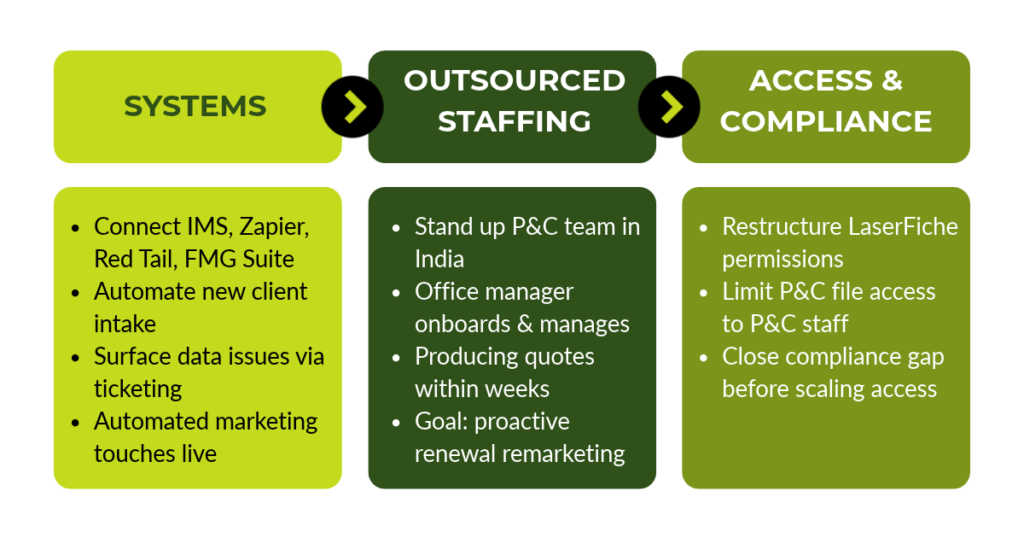
On3 rebuilt the plumbing connecting Gregg’s core systems (including IMS, Zapier, Red Tail, and FMG Suite) so that client data can be shared automatically.
- New clients now flow from IMS into Red Tail with no manual work
- A ticketing system surfaces data problems automatically
- FMG Suite marketing puts two to three automated touches a month in front of clients without Gregg doing anything.
Step Two: Fix Access and Compliance
Before outsourced staff could be trusted with real client data, the practice needed a permissions structure that didn’t exist. On3 completed a LaserFiche restructure so access to P&C files is now limited strictly to P&C staff, closing the compliance gap.
Step Three: Outsource Repetitive Processes
Rather than hire and train in-house, On3 set up an outsourced P&C support team in India, onboarded and managed by Gregg’s office manager. Within weeks the team was producing enough real work to dramatically increase Gregg’s client-facing availability, including commercial quotes, proactive renewal remarketing, and ample administrative work.
The Outcome: More Time for the One Thing That Doesn’t Scale
The new systems workstream has dramatically changed Gregg’s day-to-day experience, with:
- less manual entry,
- cleaner data, and
- marketing running in the background.
The outsourced team is ramped and producing, and now has proper, compliant access to exactly the files it needs. With that structural fix complete, the practice has a support structure that can absorb administrative and quoting volume at a scale Gregg couldn’t staff for locally, at a fraction of the cost of a local hire.
The throughline is capacity. The goal wasn’t automation or outsourcing for its own sake, but to build a mechanical structure around a high-producing advisor. Gregg’s time goes to the one thing that doesn’t scale without him: sitting across from clients and closing business.
Building a practice is mathematical. Reach out to us at On3 Strategies for a free consultation about how to grow your practice.
From Captive to Owner
How On3 Helped Tracy Randle Turn a Bank Book into an Ownable Practice
By the time On3 finished its work with Tracy Randle, she had done something most veteran bank advisors never do; traded a comfortable, high production, transactional career for something an advisor can actually own.
Tracy first crossed paths with On3 in 2017, not by her own choice. A SunTrust Bank regional director had retained On3 to coach seven producers who were closing in on the bank’s top production tier, an 18-month engagement the bank paid for. When it ended, only a handful of those advisors chose to keep working with On3 on their own dime. Tracy was one of them.
The Challenge: Big Production, No Real Business
At the time, Tracy worked at a SunTrust branch on Pennsylvania Avenue in Washington, D.C., a high traffic, working class retail location with strong foot traffic but few real wealth management opportunities. Most of what came through the door was small annuity business.
Tracy made the most of it. She built $750,000 in annual production and carried roughly 3,000 names the bank counted as “clients.” But every dollar was transactional. To hit the same number the following year, she had to go find that production all over again. Nothing compounded. Nothing recurred. After 25 years in the business, Tracy had a demanding, high earning career with almost no durable equity in it, on a 34% payout grid.
The math made change harder, not easier. A recurring, planning based model meant a real pay cut on income she had built her life around, exactly the tradeoff that keeps most veteran producers stuck. Tracy needed outside help to make it stick, which is why she kept On3 on after the bank-funded engagement ended.
The Plan: A Deliberate Path to Independence
Jumping straight from a bank platform to full independence was not the right first move. On3 and Tracy identified a deliberate middle step instead, then used it to build the case for real ownership.
Step One: Find the Right Platform.
On3 helped Tracy move to Wells Fargo, a firm with the bank model familiarity she knew, but there was real room to grow:
- An advisory and brokerage channel alongside the bank channel
- A developing independent Wells Fargo FiNet channel
- A transition assistance package to support her income while she built recurring revenue and planning business.
The move placed her in Wells Fargo’s Alexandria, Virginia branch, a far wealthier market than Pennsylvania Avenue, and she brought her strongest relationships with her. Then COVID hit. Working from home proved she did not need a branch to serve her clients well.
Step Two: Negotiate the Move to Full Independence.
When a change in Tracy’s local management stopped supporting the direction she had built, On3 began introducing her to independent broker dealers:
- Cambridge
- Kestra
- LPL
Using relationships on the recruiting side and locally with an OSJ, On3 helped Tracy negotiate maximum transition assistance and one of the strongest available grid rates in the industry: 90%, up from 34% as a captive bank advisor. That move became the foundation for Oceanfront Financial Partners; the independent business Tracy owns today.
Step Three: Build the Business Behind the Book.
Once independent, On3 helped Tracy put real structure around the practice using On3’s Practice Builder Process.
- Client tiers segmented by assets, each with its own review cadence and planning priorities.
- A structured referral system with a thank you gesture for every referral.
- A growing network of estate attorneys and CPAs generating new business instead of Tracy chasing the next transaction.
On3’s Practice Builder Process
Working from home also removed the overhead of a branch or owned office, keeping her cost structure lean.
The Outcome: Ownership Changes the Math
Eight years after that first SunTrust engagement, Tracy runs Oceanfront Financial Partners as an independent owner instead of a captive producer. The numbers tell the story:
- Payout grid up from 34% to 90%, meaning a conservative $300,000 in production today takes home more than the $750,000 she used to produce at the bank.
- AUM at roughly $44 million, working toward a $50 million near-term target and $60 million the year after.
- A book trimmed from about 3,000 loosely defined “clients” down to a tight, high-quality group of true relationships that are far more efficient to serve well.
- Real enterprise value in the business itself. A captive bank book has none. Independent practices like Oceanfront typically sell in the 1.2 to 3 times revenue range, and Tracy is building toward the top of that range, an outcome that was never available to her before.
Building a practice is mathematical. Reach out to us at On3 Strategies for a free consultation about how to grow your practice.
RESOURCES
Our library of resources for advisors is designed to help growth-minded individuals like yourself make smarter decisions and focus on process that leads to progress. Each resource is thoughtfully built to support your growth, improve your efficiency, and help you navigate the complexities of building a firm that thrives.
THE ON3 OVERVIEW
The On3 Overview
Download the “On3 Overview” which summarizes who we are, what we do, and the On3 Equation that makes it all work.

TECHNOLOGY & CRM OPTIMIZATION
technology & crm optimization
Download the “Technology & CRM Optimization” which provides insights on how to turn your CRM into your firm’s operating system.

TARGET MARKETING & POSITIONING
TARGET MARKETING & POSITIONING
Download the “Target Marketing & Positioning” which explains our approach to establishing your voice and establish consistent campaigns.

CLIENT SERVICE & EXPERIENCE
CLIENT SERVICE & EXPERIENCE
Download the “Client Service & Experience” to understand how we help every client gets exactly the service they were promised.
PEOPLE & PERSONNEL DEVELOPMENT
PEOPLE & PERSONNEL DEVELOPMENT
Download the “People & Personnel Development” which summarizes how we help you hire your people before the need arises.